
Jason Chu’s Journey from Delaware to Beijing to LA: Identity, Hip-Hop and Activism
By Lorna Jacoby
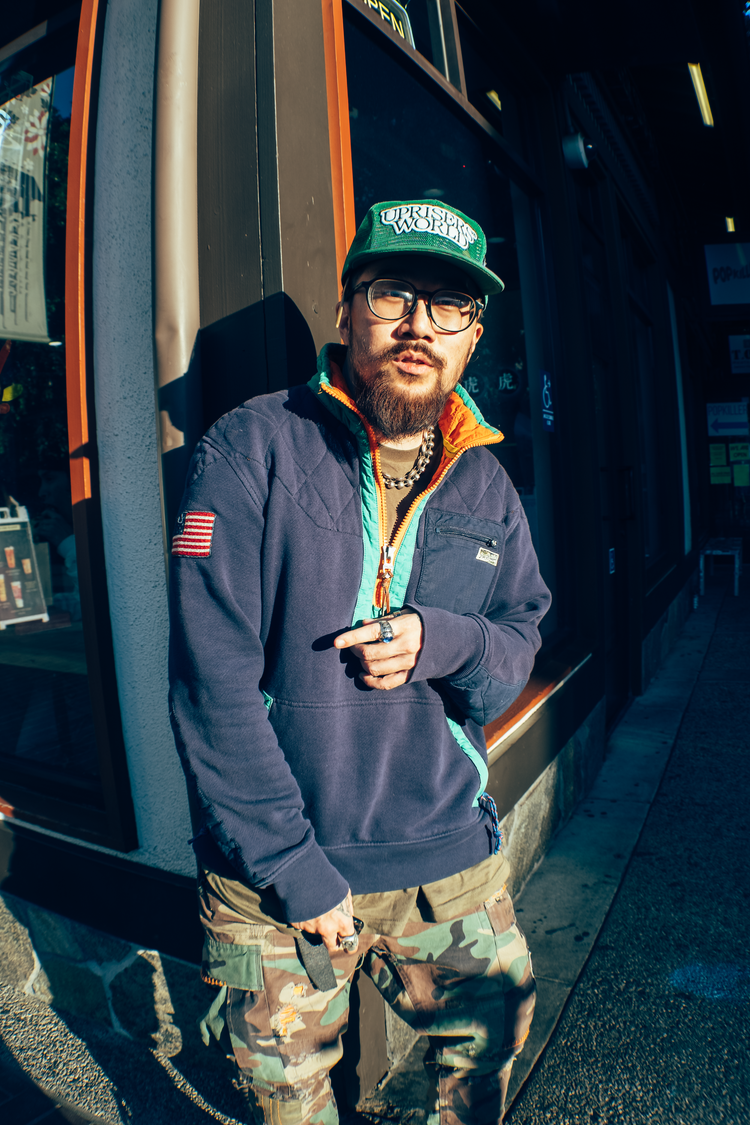
We’re thrilled to welcome Jason Chu as a voice for The Origin Stories Project. Jason speaks hope and healing in a hurting world. As a kid in suburban Delaware, he found a vocabulary for identity and liberation in hip-hop culture. He now tours extensively, matching high-energy performances with hard-hitting lyricism across the country and globally.
Growing up speaking only English, Jason studied Mandarin in college, initially as a language requirement and then more to connect with his heritage—a bridge between his father’s multilingualism, his mother’s English, and his grandmother’s Chinese. His path took him to Beijing, where he immersed himself in the rap scene, shaping a music style that flows seamlessly between Mandarin and English.
An activist, as well as an artist, he uses his music, performances and social media to tell history through a personal lens, giving voice to overlooked narratives and sparking dialogue about identity and justice. “I don’t know that we can solve the world with art,” he says, “but we can change people.” As a storyteller through music, Jason shares the joy of performing, weaving identity, heritage, and emotion into every verse — like in his song HOME from the album Living Room, which beautifully mirrors the themes at the heart of our work.
Today, Jason sees his art less as a measure of success and more as a way to bring stories to our attention — small victories and deeply personal histories that spark connection. This belief resonates deeply with our mission at the Origin Stories Project: everyone has a story worth telling.
We welcome Jason and thank him for sharing his story with us.
Modern society teaches us that self-worth is based on quantitative metrics–our social followers, our bank account balance, etc. But I believe, like Mark Twain said, that “there’s no such thing as an uninteresting life.”
Jason Chu
Saffron Arts & Culture: What first drew you toward using your music (art/poetry/rap) as a vehicle for social activism, and was there a specific moment or experience when you realized this would be your life’s work?
Jason Chu: I’d been making music for a while as a hobby and side pursuit. One day, I was visiting a musician friend and chatting about what we were learning outside of music. After a long conversation about race and cultural identity, he said–”Jason, you should really open up more about this in your music. I think it’ll give it a new urgency.” And he was right!
SA&C: Your work often carries deep emotional weight. What moves you—on a human level—to keep creating and speaking truth, even when the topics are challenging or controversial?
JC: Honestly, creating work around challenging, controversial, timely topics is what drives me forward. From music to the social media videos I make, nothing fires me up more than seeing the stories I tell help people navigate questions they’re already asking about the world. I want my art to give people tools to understand why the world is how it is.
SA&C: How did you first meet OSP founder Elaine Tajima Johnston, and what about her vision for the initiative resonated so strongly with you that you chose to become involved with it?
JC: Elaine initially contacted me to make a story box for the Project–and after our first conversation, I knew that the Origin Stories vision resonated strongly with my own arts practice! It’s not just about making pleasant or interesting art but helping people to see themselves & the humans around them with empathy and care. I needed to get involved!
SA&C: The Origin Stories Project is rooted in knowing where we come from and telling those stories with care. How do you see the mission of OSP aligning with your beliefs?
JC: Today’s world sorts and categorizes us in dozens of ways. From political affiliation to algorithmic curation, we’re encouraged to stick to our own bubbles and never connect with the humanity on the other side of the wall. By encouraging self-reflection and listening to others, The Origin Stories Project is taking a countercultural stance–asking people to consider the real humanity of “the other.”
SA&C: You’ve written some of your most powerful and controversial songs by confronting issues others might shy away from. Can you share one lyric that has sparked the most dialogue or pushback, and why you felt it had to be said?
JC: More than any individual lyric, I think what I stand for–sharing the reality of history, being a proud man of color, unapologetically caring about marginalized communities–is what’s been most controversial. But when I was a young Chinese kid in the East Coast suburbs, it was voices like these that gave me hope and direction. So I keep speaking my truth because I know there are others out there who can benefit from my storytelling.
SA&C: Has there ever been a time when the reaction to your compositions/music/rap made you question your approach—and if so, what kept you from pulling back?
JC: It’s never fun to get pushback–I’m getting comments from haters on Instagram as we speak! But my mom raised me to hold to my convictions, and I believe deeply in my work. So I’ve refined my approach, become a better storyteller, etc., and no, I’ve never questioned the fundamental direction or purpose of my work.
SA&C: Creative activism can be consuming. What practices, communities, or personal philosophies keep you going when the work gets heavy?
JC: The people who know and love me keep me going! Over my 15-year career, I’ve often despaired of ever “breaking through”. But I’ve found that my close friends often have more faith in me than I do. When I’m creatively exhausted, sitting with them has always restored my energy.
SA&C: As spokesperson for The Origin Stories Project, what projects or collaborations are you most excited to bring to life?
JC: I’m most excited to bring The Origin Stories Project into high schools. We’ve seen schools steadily losing arts funding and cutting programs that help students find their voices at this crucial age. We have a chance to give students encouragement, guidance, and praise for self-reflection and personal storytelling. When I was a kid, hip hop music gave me a platform to understand myself and the world around me–now it’s time for us to do that for a new generation of students.
SA&C: Why do you think storytelling is such a powerful tool for healing, justice, and community building—and how do you personally approach telling a story in a way that resonates across cultures?
JC: Modern society teaches us that self-worth is based on quantitative metrics–our social followers, our bank account balance, etc. But I believe, like Mark Twain said, that “there’s no such thing as an uninteresting life.” Becoming storytellers teaches us to uncover the tremendous victories and struggles hidden in the lives around us. We can then begin to extend human dignity to people we’d otherwise dismiss.
SA&C: If you could envision the long-term legacy of The Origin Stories Project, and your own role within it, what would you hope people will say 20 years from now about the stories you’ve helped tell?
JC: I see The Origin Stories Project becoming a definitive storytelling program. It’ll train generations of young storytellers in thoughtful self-reflection, skillful sharing, and empathetic listening to others. Alumni will have gone on to varied pursuits, but wherever they go, they’ll be considerate voices for human dignity and advocates for the stories that would otherwise go unheard.
SA&C: Thank you, Jason, for spending time with us to help us know you better.
For more on Jason and if you’d like to listen to some of his music please check out his site. Have a look at Jason’s box for OSP here and follow him on Instagram and Facebook.